
Update — May 2026
This article has been updated with a custom fantasy prompt generator formula that you can copy and use to instantly scale your lore creation.
Finding the best AI for worldbuilding is easily one of the most rewarding parts of storytelling, but it can also be a massive administrative headache. Keeping track of political structures, historical timelines, complex magic systems, and character bloodlines across thousands of pages is enough to give any creator writer’s block.
If you are searching for the best AI for worldbuilding, you have likely realized that general copywriting tools just don’t cut it. To build a truly immersive universe, you need platforms that can handle long-term narrative memory, structural continuity, and specialized lore generation.
In this guide, we break down the best AI for worldbuilding tools in 2026, comparing their strengths in deep lore creation, magic system design, and spatial organization.
What Makes a Great AI Worldbuilding Tool?
When evaluating the best AI for worldbuilding, a tool shouldn’t just write generic text. To actually save you time and expand your imagination, a worldbuilding assistant should excel in:
- Contextual Memory: The ability to remember established rules of your world 50 pages later.
- Structured Templates: Wiki-style organization for factions, geographic locations, and relics.
- Logical Continuity: Catching inconsistencies in your timelines or historical eras.



Here is how the top platforms rank for serious fantasy and sci-fi creators.
1. ChatGPT (OpenAI) – Best for Fast Ideation and Cultural Brainstorming
OpenAI’s ChatGPT remains one of the most flexible and accessible platforms for foundational worldbuilding. While it isn’t structured like a database, its raw creative agility makes it an unmatched sparring partner for developing fictional societies, linguistics, and political lore from scratch.
Key Features for Worldbuilders:
- Language Construction: Easily generates grammar rules, vocabulary, and naming conventions for fictional dialects.
- Societal Frameworks: Ideate complex governmental hierarchies, religious pantheons, and cultural taboos.
- Visual Inspiration: Using built-in image models (like GPT-4o), you can instantly generate concept art for historical relics, castle architecture, or landscape maps.
Pro-Tip Worldbuilding Prompt:
“I am building a dark fantasy setting. Help me design a rare, localized magic anomaly where physical memories can haunt or alter the geography of an ancient forest. Give me three distinct rules for how a traveler accidentally triggers these memory echoes,
one major psychological risk for interacting with them, and two original name ideas for this phenomenon.”
Example AI Output:
Phenomenon Name Ideas:
- The Mnemic Bleed
- Echo-Root Thickets
Three Rules for Triggering Memory Echoes:
- The Rule of Emotional Resonance: An echo is instantly triggered if a traveler enters a grove while experiencing the exact same acute emotion (e.g., intense grief, betrayal, or sudden panic) that occurred there in the past.
- The Rule of Blood-Soil Contact: If a traveler bleeds onto the roots of an elder tree, the forest pulls a memory from the soil and physically reshapes the surrounding terrain (collapsing paths or raising thickets) to match the layout of that memory.
- The Rule of Relic Disruption: Carrying an object into the forest that belonged to someone who died there forces a localized “flashback,” causing the traveler to see and feel a past event looping in real-time.
One Major Psychological Risk:
Memory Grafting: The longer a traveler stands inside an active echo, the more the forest tries to integrate them into the past. Upon leaving, the traveler permanently retains those foreign, dead memories, gradually losing the ability to distinguish their own childhood from the history of the woods.
Once ChatGPT builds the lore framework, you can use an AI image or animation tool to visually bring your new setting to life—just like this memory-haunted elder forest we generated.
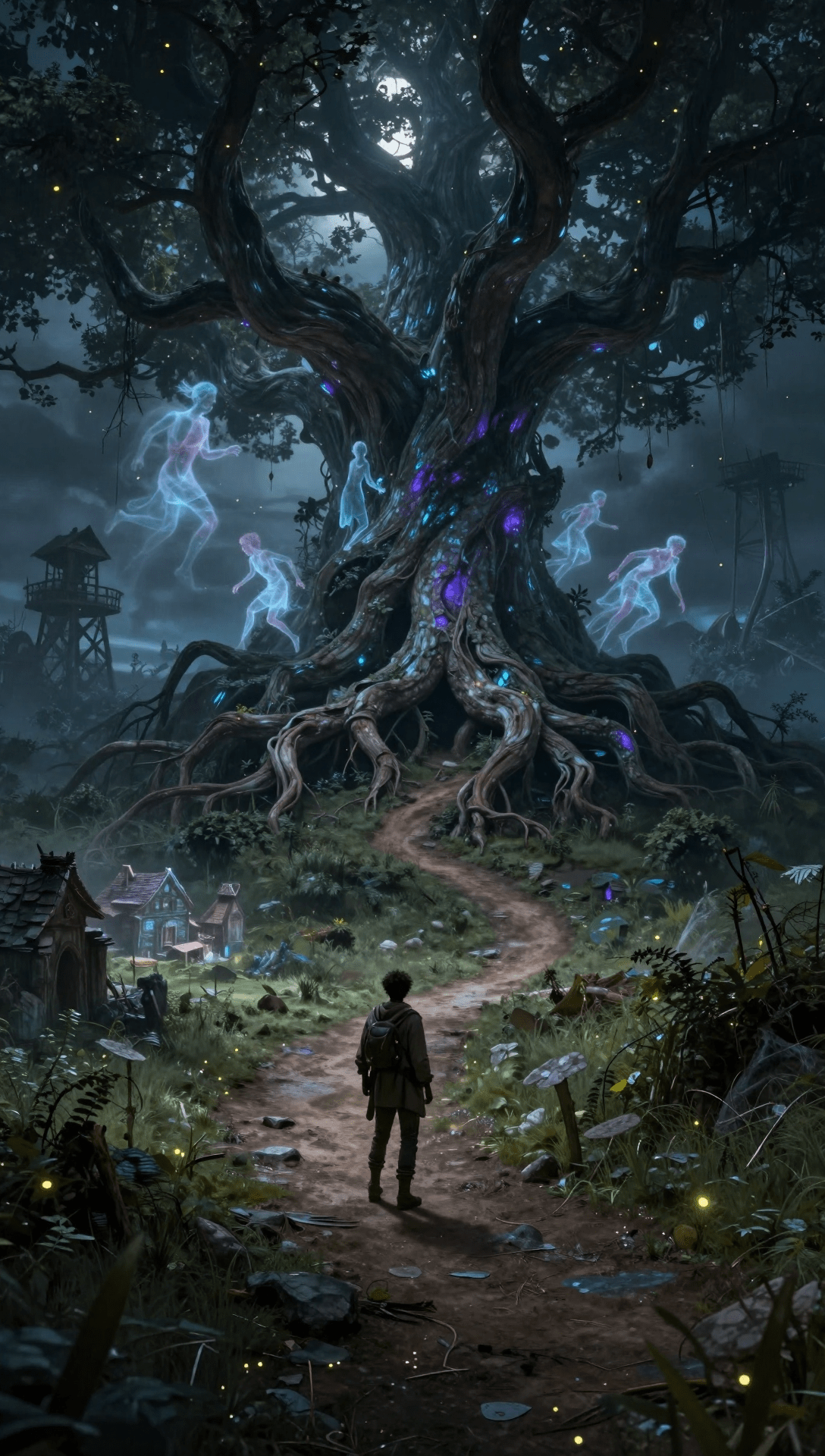
Prompt: A dramatic, wide fantasy landscape photograph of an ancient, twisted forest under a moonlit sky. The massive, gnarled roots of an elder tree glow with faint, pulsing blue and purple light where they intertwine with the soil. Ephemeral, semi-transparent human figures (past travellers) are seen rising from the roots, caught in spectral, looping memory-echoes of grief and sudden panic. The surrounding geography appears in flux, with ghostly, overlaid images of a past village and a collapsed watchtower shimmering and distorting the physical dirt path and thickets, illustrating a ‘mnemic bleed.’ A lone, bewildered traveler in robust gear stands on the path, overlapping slightly with a spectral scene, showcasing ‘memory grafting.’ Golden fireflies swirl beneath the canopy. Atmospheric, moody lighting with a cinematic aesthetic. Detailed digital art style, perfect for a professional fantasy asset.
Prompt: The camera begins a slow, smooth push-in from a wide angle, revealing the ancient gnarled tree roots pulsing with soft blue and purple magical light. Faint, smoky silhouettes phase into view above the soil, looping through slow, sorrowful gestures before dissolving back into the air. Eerie ground fog drifts slowly across the dark dirt path from right to left while tiny golden fireflies blink on and off, floating softly through the night air under the moonlit forest canopy. The frame settles as the camera continues its steady drift toward the center elder tree, maintaining the deep sense of atmospheric mystery. The glowing light within the roots pulses rhythmically, and the spectral figures sway in place without abrupt movement. The camera gently shifts to a closer perspective of the tree trunk, highlighting the photorealistic textures of the bark and the soft interplay of moonlight and magical luminescence. The fireflies float softly through the foreground as the fog continues its slow drift. The shot holds steady on the elder tree, capturing the calm stillness of the scene. A neutral hold with subtle breathing of the magical light and a final still posture of the spectral figures.
How to Use ChatGPT as a Fantasy Prompt Generator
If you want an instant way to spin up highly descriptive environmental details without running out of ideas, you can train ChatGPT to behave like an interactive generator.
Copy and paste this exact system prompt into your chat to set it up:
“Act as a fantasy prompt generator. I will provide you with a basic concept (such as ‘ancient library’ or ‘sky fortress’), and you will generate a highly detailed, sensory-rich paragraph describing the architecture, atmospheric lighting, and hidden magical secrets of that setting for my worldbuilding lore.”
Using a structural template like this ensures that every time you throw a quick idea at the AI, it automatically passes back deep, immersive text that matches the exact mood of your universe.

2. World Anvil – Best for Wiki-Style Organization and Campaign Management
If you have a massive world scattered across twenty different Google Docs, World Anvil is the ultimate structural cure. While it started as a pure database framework for authors and game masters, its deeply integrated interactive features make it a powerhouse for organizing deep lore.
Key Features for Worldbuilders:
- 25+ Worldbuilding Templates: Specialized structural formats designed specifically for countries, military conflicts, species, and myths.
- Interactive Timelines: Easily map out historical eras and character bloodlines to prevent narrative drift or logical plot holes.
- Interactive Mapping: Drop pins onto your regional maps and link them directly to lore wiki articles you’ve written.



3. NovelAI – Best for Dynamic Continuity and Context Tracking
For writers who want an AI that actively co-writes and maintains a flawless memory of their world’s rules, NovelAI is the undisputed champion in 2026. Powered by text models fine-tuned purely on published fiction, it reads like literature rather than an AI chatbot.
Key Features for Worldbuilders:
- The Lorebook System: A highly advanced database where you define characters, factions, and objects. The AI automatically references this lore dynamically whenever an activation keyword is typed in your story.
- Massive Context Window: Its expansive memory ensures the AI remembers historical events or magic constraints established chapters ago.
- No Content Restrictions: Perfect for dark fantasy or mature sci-fi writers who don’t want strict algorithmic filters blocking their creative freedom.
4. Sudowrite – Best for Fleshing Out Sensory Scenes and Outlines
Sudowrite is an AI assistant designed entirely around the fiction-writing workflow. While it excels at expanding rough drafts into beautiful prose, its brainstorming modules are exceptionally well-tuned for breaking through worldbuilder’s block.
Key Features for Worldbuilders:
- “Describe” Feature: Highlight a generic fantasy setting and instantly generate sensory details (sight, sound, smell, texture) to make the location feel alive.
- Brainstorming Engine: A specialized workspace designed to infinitely spit out original names, magical creatures, anomalous weather phenomena, and plot twists based on your world’s constraints.

5. Writesonic – Best for High-Speed Lore Generation and Blogging
Writesonic is an incredibly fast, multi-use platform. While it is highly regarded for digital marketing, its structural speed makes it an efficient tool for authors who want to quickly build lists of world elements or publish their worldbuilding progress on a blog.
Key Features for Worldbuilders:
- Rapid Generation: Perfect for generating long lists of magical items, ancient artifacts, or tavern names in seconds.
- SEO-Friendly Integration: If you are a creator building a public-facing website or portfolio for your world, Writesonic bridges the gap between creative outlines and searchable content.
6. Character.AI – Best for Roleplaying with Your Own Created Entities
If you want to test how a character or a historical figure in your world actually behaves, Character.AI offers a unique interactive approach to worldbuilding.
Key Features for Worldbuilders:
- Persona Testing: Build a custom AI chatbot representing a god, king, or villain from your lore. Chatting with them allows you to organically discover their voice, motivations, and flaws.
- Newly Integrated Lorebooks (2026): Character.AI’s recent structural updates allow creators to attach dedicated lorebooks directly to their characters, keeping their responses deeply grounded in your fictional canon.



7. Justdone AI – Best for Consolidated Workspace Management
For creators who prefer a unified dashboard over juggling multiple open browser tabs, Justdone AI packs a wide array of text-handling utilities into a single interface. Rather than excelling at one specific narrative niche, it functions as a utilitarian toolkit for fast editing and structural adjustments.
Key Features for Worldbuilders:
- Task-Specific Micro-Templates: Features streamlined modules that allow you to quickly change the tone, style, or length of a worldbuilding snippet without changing your master file.
- Integrated Text Comparison: Easily view a rough brainstorm draft side-by-side with your polished prose, making it simpler to check if your lore rules are being followed consistently.
- Streamlined Formatting Tools: A straightforward workspace designed to clean up and organize messy, unformatted AI text outputs so they are ready to be pasted cleanly into your primary manuscript or wiki.
The Verdict: Which AI Worldbuilding Tool Should You Choose?
The right platform depends entirely on how your creative brain works:
- If you need a wiki database to organize massive timelines and maps, use World Anvil.
- If you want the absolute highest prose quality and a dynamic lore database that triggers while you write, choose NovelAI.
- If you want a flexible brainstorming partner to help build custom magic systems and cultures from scratch, stick with ChatGPT.
Once your world is mapped out, using the best AI writing software can help you turn your lore into actual story chapters.
Continue Learning AI-Powered Creativity
If you want to go deeper into AI image creation and animation, these guides expand on the techniques used in this article:
Best AI Writing Software for Creative Writing & Fiction (2026 Guide)
Explore how AI writing tools can help spark character ideas and expand your fantasy stories.
How to Craft Picture Prompts That Create Powerful AI Images
Learn how to structure prompts that generate cinematic AI art, detailed characters, and immersive fantasy environments.
How to Animate AI Images: Step-by-Step Beginner Guide
Learn how to turn static images into cinematic animated scenes using modern AI animation tools.
How Generative AI Works: The Powerful Shift in AI Image Creation
Understand how AI models interpret prompts and transform text into visual images.
How to Create Consistent AI Characters for Animation (2026 Workflow)
Discover practical techniques for building recurring AI characters that stay visually consistent across storytelling, animation, and cinematic scenes.
These guides walk through the creative side of building worlds, crafting prompts, and transforming AI images into cinematic visual stories.
Frequently Asked Questions About AI Writing Software
Q: Will using AI for worldbuilding make my fantasy world feel generic?
A: Not if you use it as a brainstorming collaborator rather than a copy-paste tool. If you give an AI a basic prompt like “write a magic system,” it will spit out predictable, overused fantasy tropes. The secret is to treat the AI like a creative director. By giving it highly specific real-world constraints, unique themes, and strict logical rules, the AI acts as a mirror to amplify and flesh out your original human ideas.
Q: How do I stop AI tools from forgetting my world’s history and character details?
A: “AI forgetfulness” happens when you exceed a model’s context window (its active memory limit). To maintain flawless consistency, you have two options. You can use purpose-built storytelling software like NovelAI or World Anvil, which use dedicated wiki-style database systems to automatically trigger lore rules whenever a keyword is typed. Alternatively, if you are using a standard chatbot like ChatGPT, maintain a master “Worldbuilding Bible” document and paste your core structural rules at the very beginning of every new chat session.
Q: Can AI worldbuilding tools generate consistent maps and visual timelines?
A: Yes, but they handle text and visuals differently. While general text models excel at mapping out the conceptual logic of historical eras or political bloodlines, specialized visual tools are required to handle the spatial layout. Platforms like World Anvil allow you to upload high-resolution maps and physically pin your generated lore directly onto locations, bridging the gap between text-based lore and spatial design.
Q: What is the best AI for worldbuilding (free) when starting out?
A: For wide-open, conversational brainstorming without upfront costs, the free tiers of ChatGPT and Google Gemini are unmatched. They provide a massive, flexible knowledge base for mashing up unique cultural, historical, and linguistic ideas. If you require structural organization and tracking templates right away without paying for a subscription, specialized offline tools like Fantasia Archive offer a completely free workspace to build out your encyclopedic wiki notes.
See the project in action on:
When used strategically, the best AI for worldbuilding helps authors maintain consistency across characters, lore, and long-form storytelling.
Ready to level up your writing with a little AI magic? Visit our homepage to explore tools, tips, and inspiration designed to help storytellers like you bring their worlds to life.
Leave a Reply